Nutrition has always run on data. Ingredients, quantities, recipes, serving sizes, nutrient values, allergens, dietary records, and food composition databases. That information sits behind almost every nutrition decision, whether you’re a dietitian reviewing intake, a food scientist developing a product, or a food business building compliant nutrition labels. AI is changing how quickly that information can be captured, interpreted, organized, and analyzed.
We’re already seeing artificial intelligence used for food recognition, dietary assessment, nutrition data extraction, personalized nutrition, and other applications. Research into AI applications for measuring food and nutrient intake has explored everything from analyzing food images to estimating nutrient intake and identifying patterns in food consumption.
But there’s a core reality that doesn’t change: AI has enormous potential in nutrition, but its usefulness depends on the quality of the nutrition data behind it.
Key Takeaways
- AI is already being used for food recognition, dietary assessment, nutrition data extraction, personalization, and food-data management.
- AI can reduce manual work and make large amounts of nutrition information easier to process.
- AI-generated nutrition estimates are not the same as nutrition analysis based on actual recipes, quantities, serving sizes, and established nutrient data.
- As more AI-powered nutrition tools become available, it is increasingly important to understand where their nutrition information comes from and what assumptions are being made.
- For food businesses, AI is most valuable when it works alongside reliable food data and structured nutrition workflows.
- AI is more likely to change how nutrition professionals work than replace the expertise, context, and validation they provide.
Where AI Is Already Being Used in Nutrition
AI in nutrition isn’t hypothetical. It’s already being applied in real tools and research, especially where nutrition work involves repetitive data handling, image recognition, or large amounts of information.
Food Recognition and Dietary Assessment
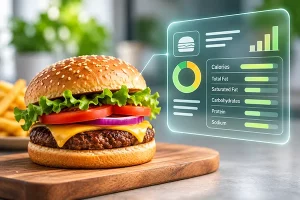
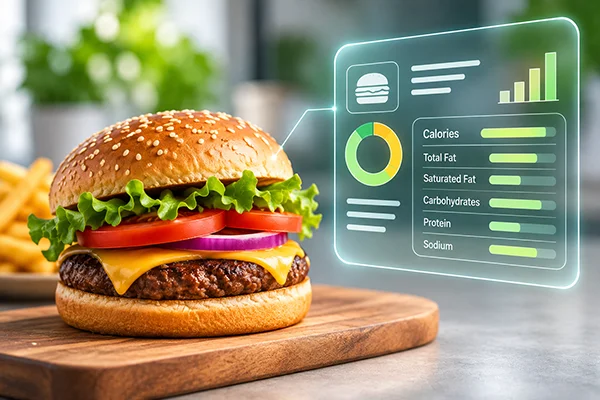
Computer vision models can identify foods from photographs and help estimate portions, calories, and nutrients based on what’s visible.
The technology has made significant progress. A 2024 scoping review of artificial intelligence applications for food and nutrient intake measurement examined 25 studies using inputs including food images, wearable sensor data, and text. Applications included food detection, nutrient estimation, dietary intake assessment, and food intake prediction.
At the same time, accuracy can vary substantially depending on the food, dataset, and method being used. A systematic review of AI-based digital image dietary assessment found wide variation in calorie and food-volume estimation and concluded that current tools still need further development before being used as standalone dietary assessment methods in nutrition research or clinical practice.
There’s an immediate limitation: recognizing a food isn’t the same as knowing its formulation.
A photo can suggest “granola,” but it may not reliably reveal the exact brand, sweetener, oil content, recipe variation, or portion weight. In nutrition analysis, those details can be the difference between a useful estimate and an accurate calculation.
Nutrition Data Extraction
Another practical application of AI is turning information that would otherwise need to be manually entered into structured, usable data.
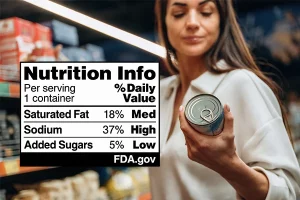
Nutrition information can exist across labels, laboratory reports, specification sheets, ingredient information, supplier documentation, and other sources. AI can help interpret that information and reduce the amount of copying, retyping, and formatting required before it can be reviewed and used.
For food businesses managing large amounts of ingredient and product information, reducing that manual work can have value beyond simply saving a few minutes. It can make nutrition data easier to capture and maintain at scale.
Personalized Nutrition
AI is also being explored as a way to support more individualized nutrition recommendations by analyzing combinations of dietary patterns, preferences, behaviours, health information, and other data.
This is a rapidly growing research area. A 2025 review of artificial intelligence in precision nutrition identified 198 articles, with approximately 75% of them published since 2020.
The potential is significant, but personalized nutrition is only one part of the larger impact AI is having on how nutrition information is processed and used.
AI Can Help Nutrition Professionals Work With More Data
The biggest benefit of AI isn’t simply “doing things faster.” It’s helping people work with an amount of nutrition information that becomes difficult to manage manually.
One recipe is relatively simple to review. But real-world food operations can involve hundreds of recipes, thousands of ingredients, multiple suppliers and specification sheets, changing formulations, allergen information, multiple label formats, and ongoing reporting requirements.
That’s not just a calculation problem. It’s a scale problem.
In a traditional workflow, information may be collected from multiple sources, entered into systems, searched, calculated, compared, and reviewed. That process can become increasingly difficult to manage as the number of recipes, ingredients, suppliers, and product variations grows.
AI can assist with some of that work by helping teams:
- capture and structure information;
- search large datasets and recipe libraries;
- identify patterns or potential inconsistencies;
- process information from different formats;
- reduce repetitive data entry; and
- make large amounts of food data easier to navigate.
The goal isn’t to remove human oversight. It’s to reduce repetitive work so professionals can spend more time reviewing, validating, interpreting, and acting on the information.
Will AI Replace Nutritionists and Dietitians?

AI is more likely to change nutrition work than replace nutrition professionals. Many time-consuming nutrition tasks involve collecting information, entering it into systems, searching across documents, comparing data, and repeating similar processes across products or recipes.
As AI tools improve, more of that front-end work can be accelerated.
The professional role can then focus more heavily on reviewing outputs, validating assumptions, interpreting results, making decisions, and communicating recommendations. AI can reduce some of the busywork within nutrition workflows, but human expertise remains important for accuracy, context, judgment, and accountability.
Research into image-based food recognition for dietary assessment has highlighted both the potential of these systems in professional dietetic practice and the technical challenges that still need to be addressed.
Not Every AI Nutrition Tool Provides Reliable Nutrition Analysis
As AI becomes more accessible, consumers and food professionals have more tools available that can generate nutrition information from a photo, recipe description, prompt, or other input.
That convenience creates an important distinction:
Generating a nutrition estimate is not necessarily the same as performing nutrition analysis. Accurate recipe-based nutrition analysis can depend on factors such as:
- the exact ingredient
- ingredient quantity
- preparation or processing method
- recipe yield
- serving size
- nutrient source or database
- the actual formulation of the product.
An AI system may infer some of these variables rather than actually know them. That can produce something particularly problematic: a result that looks extremely precise but is based partly on assumptions.
Research illustrates why that distinction matters. A systematic review comparing AI-based dietary assessment with human assessment and ground truth found that average relative errors reported across studies varied widely. Errors for calorie estimates ranged from approximately 0.1% to 38%, while errors for food-volume estimates ranged from approximately 0.1% to 33%.
Importantly, the review also found lower error ranges when images contained single or simpler foods. In other words, performance depends heavily on what the AI is being asked to interpret.
AI Estimates vs. Recipe-Based Nutrition Analysis
| AI-generated nutrition estimate | Recipe-based nutrition analysis | |
| Ingredients | May infer ingredients | Uses defined ingredients |
| Quantities | May estimate quantities | Uses actual recipe quantities |
| Portion/serving | May assume portion size | Uses defined serving information |
| Data source | Depends on the model and available context | Uses established nutrient data |
| Best use | Useful for quick estimates | Designed for repeatable analysis |
| Labelling suitability | May not be suitable for commercial labelling | Can support nutrition labelling workflows |
An approximate estimate might be perfectly useful for someone wondering roughly how many calories were in their lunch.
It’s a very different matter when nutrition information is being used for a commercial food product, nutrition facts labelling, allergen review, product development, or regulatory requirements.
What AI Still Gets Wrong About Nutrition
AI can be extremely helpful, but nutrition is full of missing context and variables that may not be visible to an AI system.
Food Is More Complicated Than It Looks
Two visually identical bowls of pasta could contain very different amounts of oil, cheese, sodium, protein, calories, and allergens.
Recognizing “pasta” isn’t the same as knowing the recipe. This is a fundamental challenge of image-based nutrition analysis. Research into image-based food recognition systems has identified food-volume and nutrient estimation as particularly challenging stages, partly because a two-dimensional image may not provide enough information to accurately determine the volume of a food.
Even when a system correctly identifies what a food appears to be, it may still need to estimate how much of it is present before nutritional values can be calculated.
AI Can Be Confident and Still Be Wrong
One of the biggest risks with AI-generated nutrition analysis outputs is that they can look authoritative. Numbers like 487 calories, 21.3 g protein, or 684 mg sodium feel precise. But the presence of decimal places doesn’t necessarily mean the underlying calculation is precise.
If the system has inferred the portion size, ingredients, quantities, or cooking method, the output can have high precision on the screen without high certainty behind the calculation. That distinction matters when nutrition information moves from an estimate to something a business intends to rely on.
Human Review Still Matters
AI is best positioned as a tool that supports professionals rather than an autonomous authority.
Nutritionists, dietitians, food scientists, regulatory teams, chefs, QA teams, and other professionals provide context and validation that cannot simply be assumed from an AI-generated answer. The more important the output, the more important that distinction becomes.
AI and Nutrition Labelling: Accuracy Matters More Than Speed
This is where the conversation becomes especially relevant for food businesses. AI can potentially accelerate data capture, ingredient management, recipe analysis, allergen review, and nutrition labelling.
But nutrition labelling requires more than generating plausible nutrition information. Food businesses need calculations tied to actual formulations: ingredients, quantities, yields, and serving sizes. They also need the ability to update those calculations and regenerate outputs as products and recipes change.
AI can accelerate the path to a nutrition label. It shouldn’t turn nutrition labelling into guesswork.
This becomes even more important as a business grows. A change to one ingredient or formulation can affect nutrition values, ingredient lists, allergen information, and other downstream outputs.
The challenge is therefore not simply generating nutrition information faster. It’s maintaining accurate, connected information as the underlying food data changes.
From Nutrition Analysis to Connected Food Data
Food businesses don’t manage nutrition in isolation. Nutrition information is connected to ingredients, recipes, allergens, labels, and reporting. When those pieces live in separate tools, spreadsheets, or duplicated documents, teams can spend significant time re-entering information, reconciling mismatches, and updating outputs manually.
A connected food-data workflow keeps those relationships intact. Ingredient data feeds recipes. Recipes drive nutrition analysis. Nutrition and ingredient data support allergen review. Those same inputs can then be used for labelling and reporting.
This is where AI becomes particularly interesting. Rather than replacing the underlying system, AI can become a layer that helps people work with it by extracting information, organizing data, assisting with searches, identifying potential inconsistencies, and reducing repetitive work.
The intelligence may come from AI, but the reliability still comes from maintaining trustworthy data and the relationships between them.
What Does the Future of AI in Nutrition Look Like?
AI in nutrition is developing quickly, and research continues to explore applications ranging from dietary assessment to precision nutrition. Several areas are particularly worth watching.
Better Food Recognition
AI models will likely continue improving their ability to recognize foods, ingredients, portions, and preparation methods, particularly as image recognition is combined with additional contextual information.
Research into AI applications for food and nutrient intake measurement has already demonstrated the range of approaches being explored, including food images, wearable sensors, text-based inputs, and combinations of different data types.
Multimodal Nutrition Tools
Instead of working with a single type of input, AI systems can increasingly work across photographs, documents, text, recipes, and structured nutrition data. For nutrition professionals and food businesses, that could make it easier to turn information from different sources into something that can actually be reviewed and used.
Smarter Recipe and Ingredient Management
AI can increasingly assist with repetitive tasks around ingredient data, document processing, ingredient matching, formulation changes, and large recipe libraries. For organizations managing hundreds or thousands of food records, those improvements can make a significant operational difference.
More Personalized Nutrition
Precision nutrition will continue to be an important area of AI research as models become capable of working with increasingly complex combinations of individual data. The growing body of research into AI-driven precision nutrition also highlights challenges around datasets, evaluation methods, cultural representation, and equity that researchers will need to continue addressing.
More Connected Food Data
For food businesses, one of the most significant opportunities may be AI becoming integrated into the systems where food data already lives. Instead of isolated AI tools generating isolated answers, AI can support platforms where ingredient data, recipes, nutrition analysis, allergen management, labelling, and reporting remain connected. That makes AI part of the workflow rather than a replacement for it.
The Future Isn’t AI Alone. It’s AI + Reliable Nutrition Data.
AI can help nutrition professionals and food businesses capture information faster, eliminate repetitive work, work with larger datasets, and find information more efficiently. But AI doesn’t eliminate the need for reliable nutrition information. If anything, it makes the quality of the underlying data more important because AI can dramatically increase the speed at which information is processed and used.
For food businesses, the opportunity isn’t to replace nutrition analysis with AI-generated answers. It’s to combine intelligent automation with reliable food data, actual recipes, structured workflows, and professional oversight.
That is also how we are approaching AI at MenuSano. For example, MenuSano’s Custom Ingredient Scanner uses AI to reduce manual data entry. Users can upload a nutrition label or lab report, and MenuSano extracts the information to help create a custom ingredient. The information can then be reviewed before being used within the nutrition workflow.
MenuSano’s AI Allergen Detector applies AI in another practical way. It helps identify potential allergens across recipes and ingredients, making it easier for users to review allergen information and manage it across their food data. Rather than replacing professional review, AI helps surface information that may require attention and reduces the manual work involved in checking recipes.
These are practical examples of where AI can provide real value: using automation to make reliable nutrition and food-data workflows easier, rather than asking AI to replace the data and expertise those workflows depend on.
MenuSano brings recipe management, nutrition analysis, allergen management, nutrition labelling, and food data together in one connected platform.