IU to mcg/mg Converter for Supplement Facts Labels

Convert Vitamin A, D, and E units for FDA and CFIA nutrition and supplement labelling workflows.

This converter is designed for food, beverage, and supplement labelling workflows. It helps convert legacy IU values into modern label units such as mcg RAE, mcg vitamin D, and mg alpha-tocopherol. It is not intended for prescription dosing, injectable medications, insulin, hCG, or clinical treatment decisions.

Use this when you need modern Nutrition Facts or Supplement Facts units, when preparing FDA- or CFIA-compliant labels, and to verify units before generating a supplement label.

no credit card required

Enter a value to see the result.

Built for nutrition and supplement labelling. Not pharmaceutical dosing.

Use this converter to translate legacy IU values for Vitamin A, Vitamin D, and Vitamin E into modern FDA/CFIA label units before creating Nutrition Facts or Supplement Facts panels.

What this IU converter does not cover

MenuSano’s IU converter is limited to nutrients commonly encountered in food and supplement labelling: Vitamin A, Vitamin D, and Vitamin E. It does not convert pharmaceutical or biologic products such as insulin, hCG, heparin, or injectable medications. Those products require product-specific medical guidance.

All-in-One Nutrition Software

From Conversion to Compliance

Discover MenuSano’s complete nutrition analysis, labelling, and compliance tools for food businesses and supplement brands.

Explore MenuSano

How to use this IU converter?

  1. Choose a Label standardFDA (US)CFIA (Canada), or Legacy IU reference.
  2. Select the Substance/form (for example: Vitamin D, Vitamin E natural, Vitamin A as mcg RAE, or a Vitamin A carotenoid source).
  3. Pick the conversion direction (for example: IU → mass or mass → IU).
  4. Enter your value and choose your mass unit (mcgmg, or g).
  5. Copy the result.

What does “Label standard” mean?

FDA (US) / CFIA (Canada) reflect modern label units where applicable:

  • Vitamin A is typically shown as mcg RAE (Retinol Activity Equivalents)
  • Vitamin E is typically shown as mg alpha‑tocopherol
  • Vitamin D is commonly shown as mcg, often with IU referenced.

Legacy IU reference is included for older IU-based references (especially for Vitamin A). If you need IU for Vitamin A, switch to the Legacy IU reference.

From IU conversion to label creation

Turn your supplement data into a compliant label

Already working with ingredient values? Take the next step and create a clean Supplement Facts label using MenuSano’s FDA-compliant supplement label generator.

FDA Supplement Label Generator

IU is potency, not weight (why the form matters)

An International Unit (IU) measures potency (biological activity). That’s why 1 IU does not equal a fixed mass across different vitamins, and sometimes even differs by form. Learn more about nutrient unit conversions for accurate labels.

  • Vitamin D: standardized conversion (straightforward)
  • Vitamin E: conversion differs for natural vs synthetic forms
  • Vitamin A: modern labelling uses mcg RAE, and conversions depend on whether Vitamin A comes from retinol or carotenoids

Using IU conversions for Supplement Facts and nutrition labelling

If you’re creating or updating a Supplement Facts label, you may need to convert older IU-based amounts into mcg or mg, depending on the nutrient and form (especially for Vitamin A and Vitamin E).

MenuSano helps food and supplement businesses generate compliant labels and nutrition analysis outputs. Check out this guide on how to create supplement facts labels.

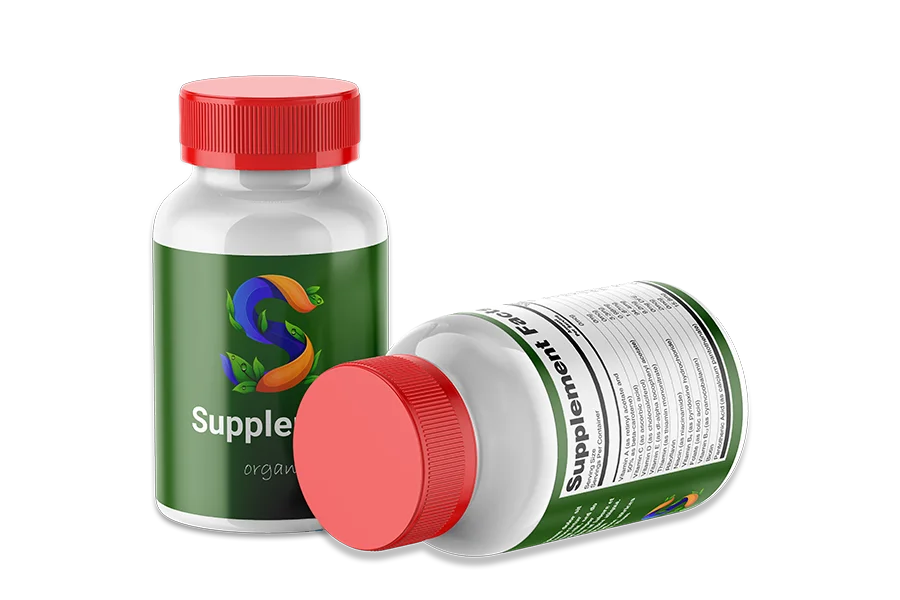
supplement label

How IU Conversions Fit Into Supplement Development, Nutrition Analysis, and Label Compliance

Converting International Units (IU) to modern mass-based units such as micrograms (mcg) and milligrams (mg) is often one small but important step in the supplement development process. While many vitamin ingredients are still supplied and documented using IU values, modern Supplement Facts and Nutrition Facts labels increasingly require nutrients to be declared using standardized units that align with current regulatory requirements.

For supplement brands, food manufacturers, contract manufacturers, formulators, and regulatory teams, accurate nutrient conversion helps ensure that formulation data, nutrition analysis results, and final labels all use consistent values throughout the product development lifecycle.

Ingredient Specifications Often Still Use IU

Many vitamin ingredients are supplied with potency information expressed in International Units. This is particularly common for Vitamins A, D, and E, where IU has historically been used to represent biological activity rather than weight.

As products move from formulation and sourcing into nutrition analysis and label creation, these values often need to be converted into the units required for modern Supplement Facts and Nutrition Facts panels.

Common sources of IU values include:

  • Supplier specifications
  • Certificates of Analysis (COAs)
  • Ingredient technical sheets
  • Legacy formulations
  • Contract manufacturing documentation
  • Historical product recipes

Because these documents frequently serve as the foundation for nutrition calculations and regulatory submissions, accurate conversion is essential before label generation begins.

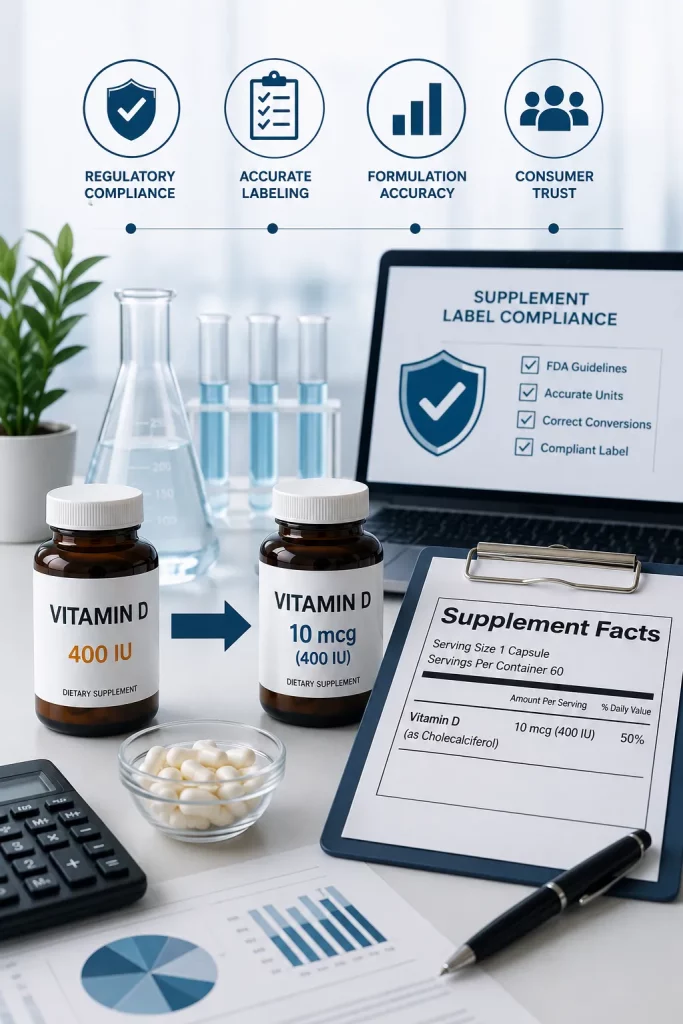
IU conversions to supplement label compliance - Vitamin D and supplement facts label on a desk with a laptop in the background

Converting IU Values Before Nutrition Analysis

Nutrition analysis relies on consistent nutrient data. When nutrient values are supplied in different units, it becomes difficult to accurately calculate serving-level nutrient content, determine Daily Values, and prepare compliant labels.

For Vitamins A, D, and E, converting IU values into the appropriate mass-based units helps create a common foundation for nutrition analysis and labelling workflows.

Many supplement and food manufacturers standardize nutrient values early in the development process to ensure that:

  • Nutrient calculations remain consistent across products
  • Formulation updates can be tracked accurately
  • Daily Value calculations are based on the correct units
  • Labels reflect the intended nutrient content
  • Regulatory reviews can be completed efficiently

Preparing FDA and CFIA Supplement Facts Labels

Modern supplement labelling regulations require careful attention to nutrient units and declaration formats. Depending on the nutrient and jurisdiction, values may need to be presented as:

  • mcg RAE for Vitamin A
  • mcg for Vitamin D
  • mg alpha-tocopherol for Vitamin E

Using the correct units is important because the same IU value can represent different amounts depending on the vitamin form being used. This is why conversion factors vary between nutrients and why accurate calculations are essential when preparing compliant labels.

Before generating a Supplement Facts or Nutrition Facts panel, manufacturers typically verify nutrient units, serving-level calculations, and regulatory requirements to ensure that label declarations are accurate and consistent with current standards.

From Formulation Data to a Compliant Supplement Label

The conversion process is often part of a larger workflow that includes formulation development, nutrition analysis, label creation, and regulatory review.

A typical supplement labelling workflow may include:

  1. Gathering ingredient specifications and supplier documentation
  2. Standardizing nutrient values and units
  3. Performing nutrition analysis calculations
  4. Determining applicable Daily Values
  5. Generating a Supplement Facts label
  6. Reviewing the label for regulatory compliance

While converting IU values is only one step in that process, it plays an important role in ensuring that nutrient declarations remain accurate from ingredient sourcing through final label approval.

Organizations that manage multiple products, formulations, or markets often use nutrition analysis and labelling software to centralize nutrient data, reduce manual calculations, and streamline compliance workflows.

FAQ

Can I use this IU converter for insulin or medications?

No. This tool is for food, beverage, and supplement labelling workflows involving Vitamin A, D, and E. It should not be used for prescription medication dosing.

Is this converter for Nutrition Facts or Supplement Facts labels?

Yes. It is intended to help convert legacy IU values into modern label units used in nutrition and supplement labelling.

What does IU mean?

IU means International Unit. It measures potency (biological activity), not weight, so IU isn’t automatically the same as mcg, mg, or g.

Why do I need to select a substance/form first?
IU-to-mass conversions depend on the vitamin and form. For example, Vitamin E differs by natural vs synthetic, and Vitamin A is handled as mcg RAE on modern labels.
No substance selected = no reliable conversion.
How do I convert mass → IU using this tool?

Select the Substance/form, choose mass → IU, enter your value, and choose your mass unit (mcg/mg/g). The calculator will apply the correct factor for the selected form.

How do I convert IU → mass using this tool?

Select the Substance/form, choose IU → mass, enter your IU value, then choose whether you want the result in mcg, mg, or g.

Can I convert IU to mg for any vitamin?

Only when that vitamin/form has a defined IU conversion factor. IU is not a universal weight unit, so “IU → mg” only works for substances with an established standard.

Vitamin D: is IU conversion straightforward?
Yes. Vitamin D is one of the most consistent conversions:
  • 1 IU = 0.025 mcg
  • 1 mcg = 40 IU
    (Works for D2 and D3.)
What is mcg RAE (Vitamin A)?

mcg RAE means micrograms of Retinol Activity Equivalents. It’s the modern way to express Vitamin A activity across different sources (retinol and carotenoids) with different bioavailability.

Why does Vitamin A conversion depend on the source (retinol vs carotenoids)?
Because different Vitamin A sources convert differently to activity (RAE). For example, beta‑carotene from food is not equivalent to retinol mcg-for-mcg. This tool uses standard RAE factors based on the option you choose (food vs supplement carotenoids).
How do I see Vitamin A in IU?
Vitamin A is shown as mcg RAE under the FDA (US) and CFIA (Canada) label standards. If you need IU, switch Label standard → Legacy IU reference to show IU conversions for Vitamin A.
Why does Vitamin E have two different conversions (natural vs synthetic)?

Vitamin E conversions differ by form: natural (d‑alpha‑tocopherol) vs synthetic (dl‑alpha‑tocopherol). Always match the factor to the form on your label. This tool supports both.

What is 1,000 IU in mg?

It depends on the vitamin/form. Select the Substance/form, enter 1,000 IU, and the tool will show the correct mg (or mcg) equivalent for that form.

Does this tool replace professional advice?

No. This tool is for conversions and labeling/formulation workflows. For medical dosing decisions, consult a qualified professional.

More Free Tools?

FREE TOOL

Free Nutrition Label Generator

Create FDA & Health Canada compliant nutrition facts labels in seconds. Perfect for food manufacturers and restaurants.

Try Label Generator
FREE TOOL

Free Food Allergen Checker

Instantly identify allergens in your recipes and ingredients. Ensure compliance and keep your customers safe.

Check Allergens
FREE TOOL

Free Shelf Life Calculator

Calculate accurate shelf life and expiration dates for your food products based on storage conditions and ingredients.

Calculate Shelf Life
FREE TOOL

Free HFSS Score Calculator

Free UK HFSS calculator for foods and drinks, fast, accurate scoring with clear results and compliant point tables.

Calculate HFSS Score

The Proof is in the Pudding

trevor's pizza image testimonial

Simple Interface, Good Feature Set, Excellent Price. Very easy to use, and comes with a short tutorial.

Trevor Nawalkowski - Trevor's Pizza

bonbon collections image testimonial

Sending our recipes to a nutritionist, or out to a lab and having to wait three weeks for results is timely. Instead we use MenuSano, a web-based nutritional calculator. It really has made this journey easier for me.

Thao Nguyen - BonBon Collections
township 27 image testimonial

MenuSano delivered on all fronts; nutrition labeling, ingredient sourcing, and all kinds of applications we hadn't even thought of. Sooo intuitive and easy to use, not sure where we would be without them!

Eric Krautheim - Township 27
boundary labels image testimonial

I was immediately impressed by their expertise and openness to feedback.

Caroline - Boundary Labels

bridgehead image testimonial

MenuSano allows us to calculate our recipes with accuracy and instantly, it checks potential variations in the recipe.

Kevin Harbison - Bridgehead

windmill bakery image testimonial

The one thing we were surprised to find out is how much sodium our recipes contain. We thought we used minimal salt but Menusano helped us discover that some of our recipes contained a surprising amount, which made us change some of our recipes.

Grace Willows - Windmill Bakery

jessica's gourmet image testimonial

The best software by far for food companies. This software saved me. I had a deadline and the person I usually get to do my nutritional was not available. Thanks to this software, we will be doing it all ourselves from now on.

Jessica Otano - Jessica's Gourmet

trelfa labs image testimonial

MenuSano was able to adapt, use creativity, grow, and even assist in projects to ensure our company met our client requests.

Jon Trelfa - Trelfa Labs


Our Features

Businesses Across Industries Trust MenuSano

Top Trends in Nutrition Labeling for 2024

Food Manufacturers

Specialized solutions for food manufacturers covering everything from nutritional analysis to compliance and labelling.

How can MenuSano help food manufacturers? ->

restaurants

Restaurants

Restaurants can use MenuSano to get real-time and accurate nutritional analysis, as well as generate nutrition facts labels.

How can MenuSano help restaurants? ->

cannabis

Cannabis

Cannabis businesses can easily navigate the intricate rules of product labelling and generate compliant nutrition facts labels by simply using MenuSano.

How can MenuSano help cannabis businesses? ->

Catering Banquet image

Catering

Our software is engineered to meet the unique needs of food caterers allowing them to focus on delivering exceptional culinary experiences.

How can MenuSano help food caterers? ->

meal-kits

Meal Kits

All-in-one solution for meal kits nutrition analysis, labelling, and compliance.

How can MenuSano help meal kit companies? ->

food-processor

Food Processors

MenuSano can integrate with supply chain management systems, facilitating real-time updates on ingredient availability, pricing, and nutritional information.

How can MenuSano help food processors? ->

bakery

Bakeries

Eliminate complex calculations and estimations. Our Bakery Nutrition Label Menu provides precise, real-time nutritional information customized to your recipes, covering everything from calories to allergens.

How can MenuSano help bakeries? ->

hospital

Hospitals

Promote healthier choices by generating informative compliant nutrition facts labels. Meals can also be catered to the diverse dietary needs of patients, staff, and visitors.

How can MenuSano help hospitals? ->

culinary-schools

Culinary Schools

MenuSano is committed to enriching the educational journey of the next wave of chefs, dieticians, and food entrepreneurs.

How can MenuSano help culinary schools? ->

pupils in canteen

School Education

Recognizing the vital role schools play in shaping future generations, MenuSano grants you access to our top-notch nutrition analysis software at a special reduced rate if teaching nutrition is part of the curriculum. 

How can MenuSano help public schools? ->

future-of-school-nutrition-programs

School Meal Programs

An easy-to-use comprehensive solution to nutritional analysis, empowering schools to deliver healthier, well-balanced meals for our future leaders.

How can MenuSano help school meal programs? ->

pet-food

Pet Food

MenuSano helps you analyze and balance essential nutrients in pet food, such as protein, fat, fibre, and essential vitamins and minerals, tailored to different species, breeds, and health conditions.

How can MenuSano help pet food companies? ->

retirement-homes

Retirement Homes

Discover how MenuSano can enhance the nutritional well-being of your residents and set your retirement home apart.

How can MenuSano help retirement homes? ->

Our Services

we-do-it-for-you

We Do it For You

We'll generate compliant labels so you can focus on what matters. Save time and let us do it for you!

lab-analysis-service

Lab Analysis Service

Laboratory testing for food items through our lab partners. Get nutrition testing, labels, and much more!

food-service-inspections

Food Service Inspections

MenuSano has partnered with Field Eagle to help businesses like you navigate food inspections effortlessly.

Latest Blog Articles

Ready to buy?

If you’re not 100% sure yet, start with our free trial and upgrade when you’re ready.

Ready to buy?

If you’re not 100% sure yet, start with our free trial and upgrade when you’re ready.

Ready to buy?

If you’re not 100% sure yet, start with our free trial and upgrade when you’re ready.

Ready to buy?

If you’re not 100% sure yet, start with our free trial and upgrade when you’re ready.

Ready to buy?

If you’re not 100% sure yet, start with our free trial and upgrade when you’re ready.

Ready to buy?

If you’re not 100% sure yet, start with our free trial and upgrade when you’re ready.

Contact Us


We take your privacy seriously and will never share your information.

The Healthy Menu Podcast

Request a Feature

Contact Us

We take your privacy seriously and will never share your information.