
A diner sits down at a restaurant, opens the menu, and sees that the pasta dish has 780 calories. What does that actually mean? For most people, the number is abstract. It doesn’t tell them whether to order it, pair it with something lighter, or swap it for a different option. A calorie count on its own is information without context.
AI wellness labelling changes that. Instead of simply showing 780 calories, the menu says: approximately 1 hour 20 minutes of walking, 13,000 steps, 45 minutes of swimming, or 1 hour of cycling. Suddenly, the number has meaning. It’s tied to something the diner can actually picture.
This is the idea behind MenuSano’s new AI Wellness Labelling module. This reflects a broader shift happening across the food service industry. Moving from compliance-only nutrition disclosure toward nutrition transparency that actually helps people make informed choices.
Why calorie-only labelling isn’t enough
Mandatory calorie labelling has been a major step forward for public health. In Canada, Ontario’s Healthy Menu Choices Act of 2015 requires restaurant chains with 20 or more locations to display calorie information on menus. In the United States, the FDA’s menu labelling rules apply to similar large chains. These laws exist because research consistently shows that people underestimate the caloric content of restaurant meals, often by 30 percent or more.
But here’s the problem: calorie numbers alone don’t change behaviour for most diners. Studies on menu labelling have shown mixed results, with some consumers reporting that they don’t know how to interpret the information. A 900-calorie meal sounds like a lot, but without a reference point, it’s just a number.
Activity-equivalent labelling, also known as PACE labelling (Physical Activity Calorie Equivalent), addresses that gap. Research from the UK, including studies published in the Journal of Epidemiology & Community Health, has found that activity-equivalent labels can measurably reduce the average calories selected from a menu. The reason is simple: “1 hour of walking to burn this off” is information a person can actually relate to.
How AI wellness labelling works
MenuSano’s AI Wellness Labelling module layers activity calculations on top of the existing nutrition analysis that operators already use to generate compliant nutrition facts labels. The workflow looks like this:
- An operator adds their recipes to MenuSano, the same way they would for a standard nutrition facts label or compliance requirement
- The platform automatically calculates the caloric content using its extensive ingredient database
- The AI Wellness Labelling module converts those calories into activity equivalents for walking, swimming, cycling, and additional activities
- Operators can display the activity equivalents on digital menu boards, QR-code menus, mobile ordering apps, in-room dining platforms, and printed menus
The activity profiles are customizable. A wellness resort can offer cycling and swimming. A corporate cafeteria can show walking and steps. A fitness-focused restaurant can add running or gym-based activities. Operators choose the frame that makes sense for their brand and their guests.
Who is AI wellness labelling for?
Activity-equivalent labelling isn’t the right fit for every food service operator, and it shouldn’t be. The operators who benefit most are the ones whose guests expect, or would welcome, a more intuitive approach to nutrition transparency.
Wellness-focused hotels and resorts. Luxury hospitality has become synonymous with wellness in recent years. Guests at spa hotels, wellness retreats, and fitness-forward resorts are paying for an experience that takes their health seriously. Activity-equivalent labelling on the in-room dining menu, the spa café, or the main restaurant is a natural extension of that promise.
Corporate cafeterias and campus dining. Employee wellness programs increasingly include nutrition transparency. Major employers in tech, finance, and professional services have introduced healthier menu defaults, calorie labelling, and even rewards for healthier eating. Activity equivalents make the data more useful for employees who are actively trying to manage their energy balance.

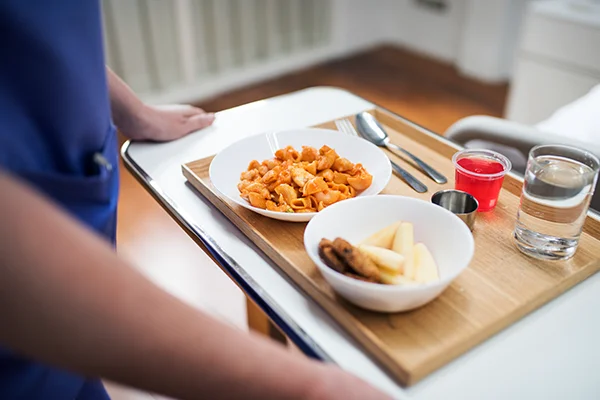
Hospitals and healthcare foodservice. Hospital cafeterias serve patients, visitors, and staff, often at stressful moments when people aren’t thinking carefully about what they eat. Programs like the Champlain Cardiovascular Disease Prevention Network’s Healthy Foods in Champlain Hospitals initiative have shown that hospitals can position themselves as role models for nutrition transparency. Activity equivalents add a further layer of context that supports recovery, prevention, and healthier visitor choices.
Universities and schools. Educational settings serve large, recurring populations of young adults whose food habits are forming. Activity-equivalent labelling in a university dining hall makes the link between food and activity tangible at the exact life stage when people are establishing long-term eating patterns.
Gyms, juice bars, and fitness-focused restaurants. For brands whose whole value proposition is built around health, calorie numbers alone feel incomplete. Activity equivalents speak the language the brand already uses.
What AI wellness labelling is not
This is worth stating clearly, because the topic is sensitive. AI wellness labelling is not a weight-loss tool, a diet tracker, or a shaming device. It is not intended to tell people what they should or shouldn’t eat. After all, it’s not a clinical intervention, and it does not replace medical or dietitian advice.
It is a way of presenting existing nutrition information in a format that many diners find more useful. Operators choose whether to display it. Diners choose whether to engage with it. The goal is context, not pressure.
Research on activity-equivalent labelling has also raised important questions about how it should be deployed. Some studies have cautioned that for individuals with disordered eating patterns, any form of calorie-plus labelling can be harmful. For this reason, MenuSano recommends that operators consult with their nutrition and wellness teams before deployment, and provide options for diners who prefer to see standard nutrition information without the activity framing.
Choice is healthy: the mission behind the module
MenuSano was founded on a simple idea: choice is healthy. When people have clear, honest information about what they’re eating, they make better decisions. When food service operators have the right tools, they can provide that information affordably, accurately, and at scale.
For me personally, this mission is rooted in my own experience. As a breast cancer survivor, I came out of my diagnosis with a deep conviction that food is medicine, and that the food industry plays an enormous role in public health outcomes, for better or worse. Every meal served in a restaurant, hotel, cafeteria, or hospital is a chance to empower someone or to miss the opportunity entirely.
The global picture demands that we take this seriously. More than one billion people worldwide are now living with obesity, and more than half a billion with type 2 diabetes. These are diseases of how we eat, and the food service industry touches billions of meals every day. Even modest improvements in nutrition transparency, at scale, can make a meaningful difference.
MenuSano’s track record in public health
AI Wellness Labelling isn’t MenuSano’s first step into public health territory. Over the past decade, MenuSano has worked with organizations and institutions that shape how nutrition information reaches the public.
Toronto Public Health selected MenuSano as the nutrition analysis software for its Savvy Diner pilot program, which ran from 2013 to 2018 and contributed to the implementation of Ontario’s Healthy Menu Choices Act. By replacing traditional laboratory nutrition analysis, which can cost up to $1,800 per menu item with a two-to-five-week turnaround, MenuSano made voluntary menu labelling feasible for independent restaurants for the first time.
In Eastern Ontario, the Champlain Cardiovascular Disease Prevention Network has used MenuSano across its Healthy Foods in Champlain Hospitals program, which includes more than 20 hospitals serving patients, staff, and visitors. The program has helped hospitals become role models for healthier food environments in the communities they serve.
The Southern Alberta Institute of Technology uses MenuSano in its Baking and Pastry Arts program, both as a teaching tool for the next generation of food service professionals and as the nutrition analysis engine for its on-campus restaurants. Food safety consultancies like Trelfa Labs and Canadian labelling specialists like Boundary Labels rely on MenuSano to provide their clients with accurate, compliant labelling across dual-panel labelling, voluntary nutrient declarations, bilingual labels, and front-of-package requirements.
This track record matters because it shows what AI wellness labelling is built on. It isn’t a standalone novelty. It’s the newest feature of a platform that has been quietly shaping nutrition transparency in Canada and beyond for more than a decade.
How to get started
The AI Wellness Labelling module is available immediately to all MenuSano customers as an add-on to any plan. Operators who are already using MenuSano for nutrition analysis and labelling can activate it without re-entering recipes. New operators can start with a free trial at menusano.com, which includes the ability to generate a fully compliant nutrition facts label at no cost.
For multi-property hospitality groups, corporate dining operators, hospital networks, and educational institutions, MenuSano offers customization and custom API access. To explore what that looks like, request a demo.
The bigger picture
We are living through a global health crisis. Obesity, diabetes, and diet-related chronic disease affect more than a billion and a half people worldwide, and the food industry sits at the center of that story. The businesses that feed people every day, the restaurants, hotels, cafeterias, hospitals, and schools, have enormous influence over what society eats and, by extension, over public health.
MenuSano exists to give that industry the tools to be part of the solution. AI Wellness Labelling is another step toward a world where choosing healthier food is easier, clearer, and more honest than it is today.
Because choice is healthy. And every small choice, multiplied across billions of meals, adds up.
About the author
Sonia Couto is the Founder of MenuSano, a Toronto-based nutrition technology company used by food manufacturers, restaurants, hotels, hospitals, public health bodies, and educational institutions in more than 30 countries. A breast cancer survivor, Sonia is a frequent speaker on nutrition transparency, food-as-medicine, and the role of technology in public health. MenuSano is part of the Konverge Group of Companies.
Frequently Asked Questions
What is AI wellness labelling?
AI wellness labelling is a feature that translates a menu item’s caloric content into everyday activity equivalents, such as the number of minutes of walking, swimming, or cycling required to expend that many calories. Instead of showing a diner an abstract number like “780 calories,” a wellness label shows “approximately 1 hour 20 minutes of walking or 45 minutes of swimming.” The goal is to give diners a more intuitive frame of reference for the energy content of their food, helping them make more informed choices. AI wellness labelling is used by hotels, restaurants, corporate cafeterias, hospitals, and wellness-focused food service operators.
How does activity-equivalent labelling work?
Activity-equivalent labelling starts with a standard nutrition analysis of each menu item. Once the caloric content is known, the software calculates how long an average adult would need to perform different activities to expend that many calories, based on established energy expenditure values for each activity. For example, walking burns roughly 4 to 5 calories per minute for most adults, while swimming can burn 7 to 10 calories per minute depending on intensity. The software converts the calorie figure into time estimates for each activity, and the results can be displayed on digital menu boards, QR-code menus, mobile ordering apps, or printed menus. With MenuSano’s AI Wellness Labelling module, these calculations are generated automatically from any recipe already entered in the platform.
Who should use AI wellness labelling?
AI wellness labelling is best suited for food service operators whose guests expect or would welcome greater nutrition transparency. The most common use cases are wellness-focused hotels and resorts, corporate cafeterias with employee wellness programs, hospitals and healthcare food service operations, universities and school dining programs, and fitness-focused restaurants, gyms, juice bars, and meal kit companies. It is generally not the right fit for quick-service restaurants targeting price-sensitive audiences, or for any setting where a simpler calorie display is more appropriate. Operators should always consult their nutrition and wellness teams before deploying activity-equivalent labelling, and provide options for diners who prefer standard nutrition information.
Is AI wellness labelling required by law?
No. AI wellness labelling is a voluntary enhancement to standard nutrition information, not a regulatory requirement. Jurisdictions such as Canada (under Ontario’s Healthy Menu Choices Act of 2015) and the United States (under FDA menu labelling rules) require calorie disclosure on menus for larger restaurant chains, but these laws do not mandate activity equivalents. Wellness labelling is offered by food service operators as an additional service to guests, typically as part of a broader commitment to nutrition transparency or wellness positioning.
Does AI wellness labelling replace nutrition facts labels?
No. AI wellness labelling is a complementary layer on top of existing nutrition information, not a replacement for compliant nutrition facts labels. Food manufacturers, packaged food producers, and restaurants subject to menu labelling laws still need standard nutrition facts labels that meet the requirements of the FDA, CFIA, UK, or other regulatory bodies. Wellness labelling adds context to the calorie figure, but it does not replace the underlying nutrition disclosure, ingredient list, or allergen declaration.
Can AI wellness labelling contribute to disordered eating?
This is an important question that operators should take seriously. Research on activity-equivalent labelling has generally found that it can reduce average calorie selection in the general population. However, it has also raised concerns that for some individuals, particularly those with a history of disordered eating, any form of calorie-plus labelling can be harmful. For this reason, AI wellness labelling should be deployed thoughtfully. MenuSano recommends that operators consult with nutrition and wellness professionals before rollout. Offer diners the option to view standard nutrition information without the activity framing, and avoid weight-loss or appearance-based messaging. The goal of wellness labelling is to add context for the average diner, not to pressure any individual.
How accurate are the activity equivalents?
Activity equivalents are estimates based on average adult energy expenditure for each activity. The actual calories a specific person burns while walking, swimming, or cycling depends on their body weight, fitness level, intensity, and other factors. For this reason, wellness labels are always presented as approximations rather than precise measurements. Typically, using language like “approximately 1 hour of walking.” MenuSano’s calculations use established metabolic equivalent (MET) values from recognized research literature. This is the same methodology used in clinical and research settings.
What does AI wellness labelling cost?
Pricing depends on the operator’s size and nature. MenuSano offers AI Wellness Labelling as an add-on to any plan, making it accessible to everyone from small independent restaurants to multi-property hospitality groups and hospital networks. Custom pricing is available for enterprise deployments involving digital menu board integration, QR-code menus, mobile apps, or API-level integration with existing restaurant technology. Operators can request a demo at menusano.com to receive pricing tailored to their use case.
Can AI wellness labelling be customized for different brands?
Yes. Activity profiles are fully customizable. A beach resort might display swimming, kayaking, and beach walking. A corporate cafeteria might show walking and steps. A cycling-focused brand might emphasize cycling and spinning. A hospital might choose low-impact activities appropriate for most patients and visitors. Operators can also customize the tone, language, and visual presentation of the wellness labels to match their brand, and can include or exclude specific activities based on what resonates with their guests.
Is MenuSano’s AI Wellness Labelling available internationally?
Yes. MenuSano serves customers in more than 30 countries, and the AI Wellness Labelling module is available to operators in any market. The underlying nutrition analysis supports FDA (United States), CFIA (Canada), and UK-compliant nutrition facts labels. Additionally, MenuSano supports bilingual and multilingual label output for operators serving diverse markets. Activity equivalents can be displayed in any language, and the calculation methodology is market-agnostic.