
Updated: October 15, 2026
Key Takeaways
- Canadian Nutrition Facts tables must follow the formatting specifications established in the Food and Drug Regulations and the Directory of Nutrition Facts Table Formats.
- A single, non-decorative sans-serif font, such as Arial or Helvetica, must be used throughout the Nutrition Facts table.
- Font sizes, font widths, line spacing, and borders vary depending on the prescribed table format and size version.
- Manufacturers must select an appropriate Nutrition Facts table format based on the applicable regulatory requirements, including available display surface.
- MenuSano helps businesses create Canadian Nutrition Facts tables, but final labels must be reviewed for compliance with applicable requirements.
Why Font and Size Matter for Canadian Nutrition Labels
In Canada, nutrition labelling requirements are established under the Food and Drugs Act and Food and Drug Regulations, with Health Canada responsible for federal food labelling policy and the Canadian Food Inspection Agency (CFIA) responsible for enforcement.
Nutrition Facts table formatting is regulated. Requirements cover font style, type size, font width, spacing, borders, and the arrangement of nutrition information. Using an incorrect format or failing to follow the applicable specifications can result in a non-compliant label.
This guide explains the formatting requirements for Canadian Nutrition Facts tables, including standard, bilingual, horizontal, simplified, and linear formats.
Fonts Permitted in Canadian Nutrition Facts Tables
Accepted Font Styles in Canada
Canadian Nutrition Facts tables must use a single, non-decorative sans-serif font, as required by section B.01.450(3)(a) of the Food and Drug Regulations.
Arial and Helvetica are examples of acceptable sans-serif fonts. Serif fonts, such as Times New Roman, and decorative or cursive fonts are not permitted.
Although the official Nutrition Facts table examples use Helvetica, manufacturers are not required to use that particular typeface. Other sans-serif fonts may be used if the resulting table meets the specifications of the applicable regulated format, including font size, width, spacing, and legibility.
The minimum type size is not universally 6 points. Requirements vary according to the Nutrition Facts table format, its prescribed size version, and the information being displayed. The Directory of Nutrition Facts Table Formats specifies the applicable dimensions.
Examples of Different Label Formats
The following examples illustrate different Canadian Nutrition Facts table formats. Each format has prescribed specifications for type size, font width, leading, borders, and spacing.
The measurements shown in an individual example apply to that particular format and size version. They should not be applied automatically to other Nutrition Facts table formats.
What is leading?
Leading is the vertical distance between the baselines of successive lines of text. It is measured in points, just like font size, but the two measurements are not interchangeable.
For example, text set in 9-point type with 11-point leading has a font size of 9 points and a baseline-to-baseline distance of 11 points.
Manufacturers should consult the Directory of Nutrition Facts Table Formats for the complete specifications of the format they are using.
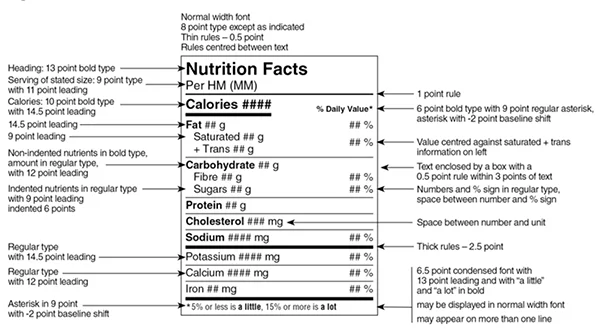
Standard Format – English
Source: Health Canada
- Nutrition Facts heading: 13-point bold type.
- Serving size: 9-point type with 11-point leading.
- Calories: 10-point bold type with 14.5-point leading.
- % Daily Value heading: 6-point bold type, with a 9-point asterisk positioned using a −2-point baseline shift.
- Nutrient rows: 9-point leading where no dividing rule is present, 12-point leading where a thin rule is present, and 14.5-point leading where a thick rule is present.
- Non-indented nutrient names: Bold type, with nutrient amounts in regular type.
- Indented nutrients: Regular type, with indentation according to the prescribed figure.
- Footnote: 6.5-point condensed type with 13-point leading. The phrases “a little” and “a lot” appear in bold.
- Outer border and thin dividing rules: 0.5 point, except where otherwise specified.
- Thick dividing rules: 2.5 points.
Other size versions may have different requirements.
Standard Format – French
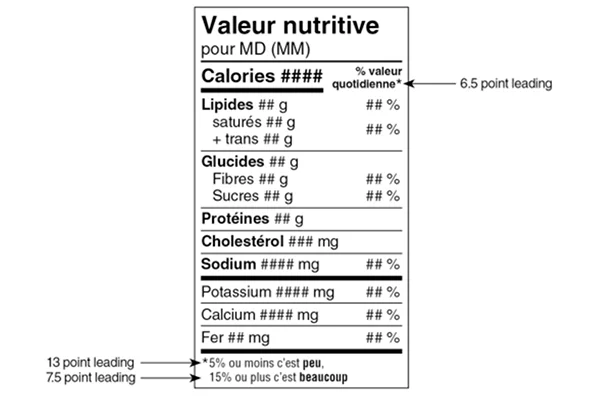
Same format specifications except for the following:
- Asterisk: 13 point leading and 7.5 point leading
- Daily Value or Valeur Quotidienne: 6.5 point leading
Bilingual Standard Format
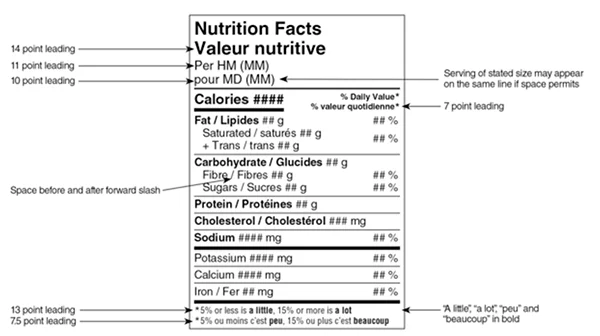
Same format specifications except for the following:
- French Heading (Valeur Nutritive): 14 point leading
- Serving Size – English: 11 point leading
- Serving Size – French: 10 point leading
- Daily Value or Valeur Quotidienne: 7 point leading
- Indented Nutrients: Space before and after forward slash
- Asterisk – English: 13 point leading
- Asterisk – French: 7.5 point leading
The order of languages may be reversed from the order shown in the image above.
Bilingual Horizontal Format
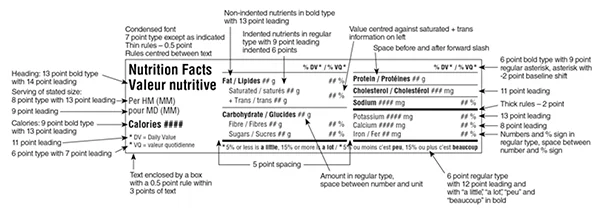
- Heading: 13 point bold type with 14 point leading
- Serving Size – English: 8 point type with 13 point leading
- Serving Size – French: 9 point leading
- Calories: 9 point bold type with 13 point leading
- Daily Value: 11 point leading
- Valeur Quotidienne: 6 point type with 7 point leading
- Non-Indented Nutrients: bold type with 13 point leading
- Indented Nutrients: regular type with 9-point leading, indented 6 points
The order of languages may be reversed from the order shown in the image above.
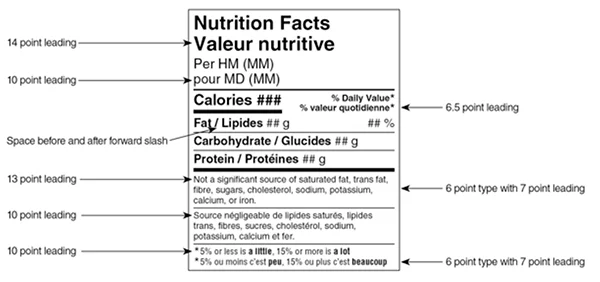
Bilingual Simplified Standard Format
The bilingual horizontal Nutrition Facts table arranges nutrition information in a wider layout while retaining the prescribed English and French declarations.
Its heading, serving-size declarations, Calories information, nutrient rows, % Daily Value headings, and footnote must follow the type-size, leading, and spacing specifications of the applicable regulated figure.
Horizontal formats are subject to the Nutrition Facts table format-selection rules. They cannot be chosen solely for design preference when the applicable hierarchy requires another format.
- French Heading (Valeur Nutritive): 14-point leading
- Serving Size – French: 10 point leading
- Valeur Quotidienne: 6.5 point leading
- Nutrients: Space before and after the forward slash
- Asterisk – English: 10 point leading
- Asterisk – French: 6 point type with 7 point leading
The order of languages may be reversed from the order shown in the image above.
Bilingual Simplified Horizontal Format
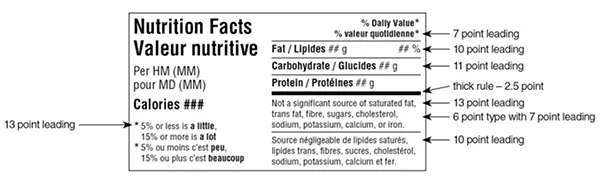
The bilingual simplified horizontal format is a space-saving presentation option for foods that qualify for simplified nutrition labelling.
It is not automatically available to every prepackaged food. Its use depends on both the simplified-format eligibility criteria and the applicable Nutrition Facts table format-selection hierarchy.
The type sizes, nutrient-value spacing, % Daily Value presentation, and dividing rules must follow the specifications of the selected regulated figure.
- Valeur Quotidienne: 7 point leading
- Nutrient Value %: 10 point leading
- Nutrient Value g: 11 point leading
- Divider: thick rule – 2.5 point
The order of languages may be reversed from the order shown in the image above.
Linear Format
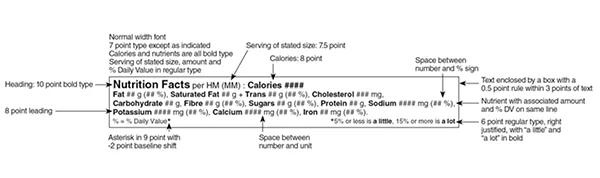
The linear Nutrition Facts table presents nutrition information in a continuous arrangement rather than the usual vertical columns.
Linear formats have restricted use under the Canadian Nutrition Facts table format-selection hierarchy. They are generally intended for packages where space or package configuration prevents the use of the applicable larger standard or horizontal formats.
Linear formats are unilingual and must display the required nutrition information according to the applicable regulated figure.
The heading, serving size, Calories, nutrient declarations, footnote, type sizes, and leading must match the selected linear-format version.
- Heading: 10 point bold type
- Serving Size: 7.5 point
- Calories: 8 point
- Nutrients: 8 point leading
- Asterisk: 6 point regular type, right justified, with “a little” and “a lot” in bold
Standardized Cannabis Symbol
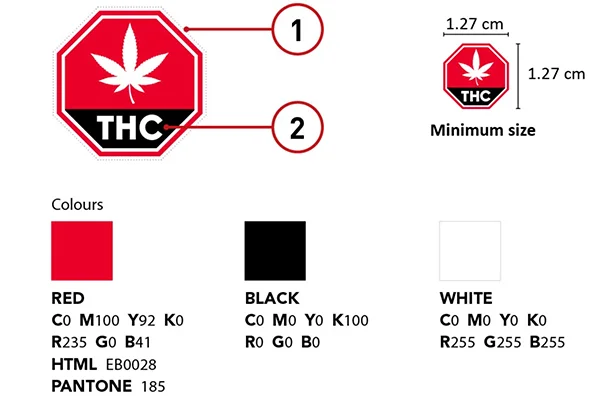
Source: Health Canada
- A white border of at least 2 points must surround all sides (the dotted line shown is for illustration only and not required).
- Positioned so the text can be read left to right when the container is viewed as it’s typically displayed or used.
Cannabis Health Warning Message with Attribution
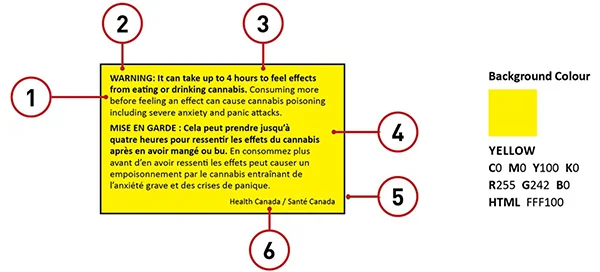
- The text must be left-aligned with no hyphenation. The second sentence should use sentence case. Use a standard sans-serif font in regular weight and width, without italics, in black. Line spacing must be at least 8 points. The font size must be at least 7 points and no smaller than the font used for the brand name.
- The word “WARNING” must be in uppercase letters and in bold type.
- The first sentence must be in sentence case, in bold type.
- Arranged so the text reads from left to right when the container is presented or seen as it normally would be during purchase or use.
- Enclosed within a solid black border at least 1 point thick, with a minimum 6-point space between the text and the border on all sides. There must be at least 3 points of space between the English and French messages if there is only one principal display panel.
- The source attribution must read “Health Canada / Santé Canada” if there’s one display panel or “Health Canada” and “Santé Canada” on separate English and French panels. Use a font size of at least 6 points, smaller than the health warning text.
Cannabis Nutrition Facts Table
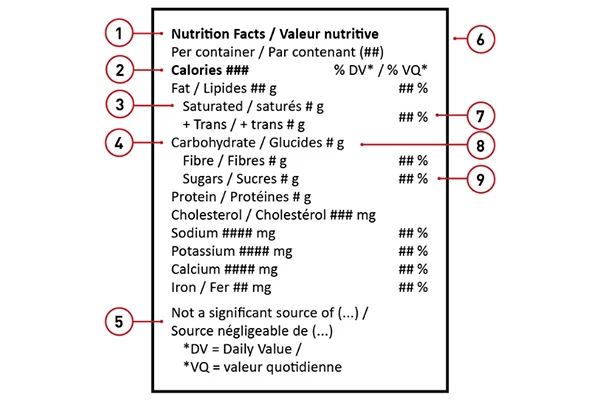
- Heading: Bold type
- Calories: Bold type
- Indented nutrients
- Non-indented nutrients
- Statement: Permitted, not required to appear in the nutrition facts table
- Black border that is a solid line of 1 point that has an inset of at least 6 points on all sides
- Value centred against saturated + trans information on the left
- Space between the number and the unit
- Space between the number and the % sign
How to Choose the Correct Canadian Nutrition Facts Table Format
Canadian food manufacturers cannot select a Nutrition Facts table format based solely on appearance or available design space. The Food and Drug Regulations establish format families and selection requirements.
Step 1: Determine the available display surface
The available display surface (ADS) is calculated according to the applicable regulatory definition. Not every part of a package necessarily counts toward the ADS.
Step 2: Identify the appropriate format family
The appropriate format depends on the food and how its nutrition information must be presented. Examples include standard, simplified, and dual formats.
Step 3: Follow the applicable format-selection hierarchy
Within the appropriate format family, manufacturers generally must consider the larger prescribed formats before moving to smaller or alternative formats, following the applicable decision tree.
Step 4: Apply the 15% principle
Generally, a Nutrition Facts table is not required to occupy more than 15% of the available display surface, subject to the rules and exceptions for particular packages, including small packages.
Step 5: Verify the final specifications
Once the appropriate format and size version have been selected, confirm the required type sizes, font widths, leading, borders, spacing, and bilingual presentation against the corresponding regulated figure.
Compliant Labels Made Easy with MenuSano
Manually formatting nutrition labels to meet CFIA standards is time-consuming and error-prone. One incorrect font size or misaligned row can mean compliance failure.
MenuSano helps food businesses calculate nutritional information and generate Canadian Nutrition Facts tables using pre-configured label formats, reducing the manual work involved in preparing nutrition labels.
MenuSano’s Canadian Labelling Solution
MenuSano allows food businesses to enter ingredients, quantities, and serving information to calculate nutritional values and create Canadian Nutrition Facts tables.
Its pre-configured label formats help simplify nutrition labelling and reduce manual formatting work. Businesses should review the final label to ensure that the selected format, nutrient declarations, bilingual information, and packaging presentation meet applicable Canadian requirements.
Read more: The Ultimate Guide to FDA Nutrition Label Fonts and Sizes
Why Canadian Food Businesses Choose MenuSano
- Canadian Nutrition Facts table formats
- Support for English and French nutrition labelling
- Nutrition calculations based on recipe ingredients and serving information
- Pre-configured label layouts
- Reduced manual formatting work
- Time savings when creating and updating nutrition labels
MenuSano helps Canadian food manufacturers streamline nutrition analysis and label preparation. Final labels should be reviewed to confirm that they meet all applicable regulatory and packaging requirements before use.
Important: Canada’s Front-of-Package Nutrition Labelling Requirements
As of January 1, 2026, Canada’s front-of-package nutrition symbol requirements apply to prepackaged foods that meet the applicable criteria, subject to regulatory exemptions and prohibitions.
Products that meet or exceed specified thresholds for saturated fat, sugars, or sodium may be required to display a front-of-package nutrition symbol.
These requirements are separate from the formatting specifications for the Nutrition Facts table. Businesses should evaluate both sets of requirements when preparing Canadian food labels.
Products imported, manufactured, or packaged at retail before January 1, 2026, may continue to be sold under the applicable transitional provisions.
Final Thoughts: Label Fonts and Sizes Rules Matter in Canada
Canadian Nutrition Facts tables must meet specific formatting requirements covering font style, type size, spacing, borders, and presentation.
The correct specifications depend on the regulated table format and size version selected for the product. Manufacturers should refer to the Food and Drug Regulations and the Directory of Nutrition Facts Table Formats rather than applying a single set of font-size measurements to every label.
MenuSano helps simplify calculations and nutrition labelling, while final regulatory compliance remains an important part of the manufacturer’s label-review process.