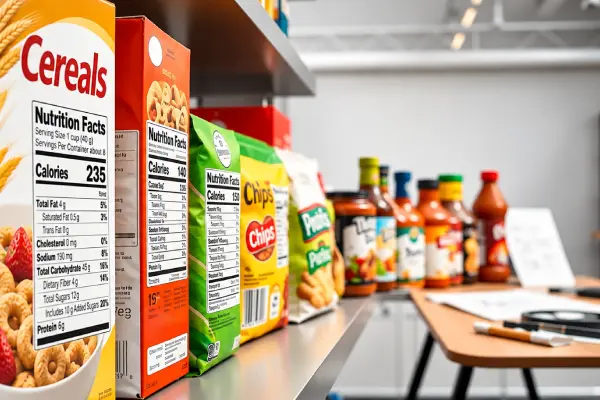
Managing nutrition and label compliance for one product is relatively straightforward. Managing it across dozens or hundreds of products is a different challenge. Every product can have its own recipe, ingredients, suppliers, serving sizes, allergens, nutrition data, claims, and packaging requirements. Those products also change over time; ingredients get replaced, suppliers change, recipes are reformulated, serving sizes are adjusted, or regulations evolve.
At scale, complexity is not just “more labels”; it is more teams, more handoffs, and more places where information can drift. Regulatory needs to trust what production is actually making. Product development needs to know what a change will trigger downstream. Packaging needs the right version at the right time, often across multiple facilities, co-manufacturers, and private-label programs.
The challenge for growing food businesses is not simply creating an accurate label once. It is keeping nutrition and labelling information accurate across an entire product portfolio as that portfolio changes. That requires more than spreadsheets and finished label files. It requires a structured way to manage the food data behind them.
Key Takeaways
- Nutrition and label compliance becomes more difficult as the number of products, ingredients, suppliers, facilities, and markets increases.
- A nutrition label should not be treated as an isolated file. It is an output of the recipe and ingredient data behind the product.
- Ingredient, supplier, recipe, serving size, or formulation changes can create downstream compliance work across many products.
- Centralizing recipe and ingredient information makes it easier to maintain consistent nutrition labelling, ingredient declarations, and allergen labelling across products.
- Businesses operating across multiple markets need to account for different labelling requirements without creating disconnected workflows.
- A connected food data workflow helps regulatory, product development, quality, and production teams work from the same underlying information.
Why Compliance Gets Harder as Your Product Portfolio Grows
Adding another product does more than add another nutrition label. It can introduce another recipe, another collection of ingredients, additional supplier information, new allergen considerations, different serving sizes, and another set of packaging information that needs to remain accurate.
At a small scale, teams may be able to manage these relationships manually. The difficulty increases as the portfolio grows. Consider a business with 100 products. Those products may share ingredients and sub-recipes. A single ingredient could appear in dozens of formulations. Some products may be sold in multiple sizes. Others may be produced for different markets. Some may be made in different facilities with slightly different supplier realities. Now consider what happens when one frequently used ingredient changes; then food businesses need to find out:
- Which recipes contain the ingredient
- Whether the nutrition values have changed
- Whether the ingredient declaration has changed
- Whether allergen information is affected
- Whether nutrition claims are still valid
- Whether nutrition or front-of-package requirements are affected
- Which existing labels or packaging files need to be reviewed
The work is no longer about updating one recipe. It is about understanding the relationships between food data across the product portfolio.
A Nutrition Label Should Not Be an Isolated File
One of the biggest problems with managing compliance at scale is treating the nutrition label as the final source of information. It isn’t. A label is an output based on the product formulation and the data associated with that formulation. Ingredients inform the recipe, and the recipe provides the foundation for nutrition analysis. That analysis, together with other regulatory information, is then used to create the appropriate nutrition label, ingredient declaration, allergen statements, and other required outputs. If the information at the beginning of that process changes, the information at the end needs to change too.
This distinction becomes particularly important when labels are stored separately from recipes. A team might have the current recipe in one spreadsheet, supplier specifications somewhere else, nutrition calculations in another file, and the final label saved as a PDF or image. At that point, the organization has several versions of the product’s information rather than one connected source of truth. This is where compliance management becomes increasingly dependent on people remembering what needs to be updated.
Signs You’ve Outgrown Spreadsheet-Based Label Management

Spreadsheets are useful tools, and for a small product portfolio they may be enough. The problem is not necessarily the spreadsheet itself. The problem is the number of relationships that teams eventually ask spreadsheets to maintain. Common signs the workflow is becoming risky include:
- You are not sure which label file is the current version
- Ingredient specifications live across emails, PDFs, shared drives, and supplier portals
- Sub-recipes are copied and pasted into multiple products instead of being maintained once
- Market variants create duplicate “versions” of the same product data
- A change depends on one person remembering which products and labels it affects
- Packaging updates become a version-control problem rather than a straightforward update
As those relationships multiply, teams often compensate with additional worksheets, formulas, file naming conventions, shared folders, and manual checks. Eventually, knowing which file contains the current information can become a process of its own.
Centralize Recipe and Ingredient Data
A more scalable approach starts with the data behind the product. Instead of managing nutrition calculations and labels as separate tasks, businesses can maintain recipes, ingredients, nutrition information, allergens, and related product information within a connected workflow.
This idea came up directly in our conversations with food businesses evaluating nutrition labelling software. One regulatory professional described wanting production and regulatory teams to put their local recipes into a system, pull the information required for packaging, and “have it all in one place.”
That requirement is important because regulatory information does not exist independently from product development and production. The recipe being manufactured should correspond to the recipe being analyzed. The ingredient information used for analysis should correspond to the ingredients being purchased. And the nutrition information used on packaging should correspond to the formulation being produced. Centralization helps make those relationships easier to manage.
Understand the Impact of Product Changes
Not every product change requires the same response. But every meaningful formulation change should trigger a question: What else does this affect? For example, replacing an ingredient with a new supplier’s version could change its nutrient profile or ingredient composition.
- Changing the quantity of an ingredient could affect nutrition values.
- Changing a sub-recipe could affect every finished product that uses it.
- Changing serving size could affect the values displayed on the nutrition label and the conditions for certain claims.
A strong compliance workflow needs to consider downstream impact rather than treating each change as an isolated edit. This becomes especially important when ingredients or sub-recipes are reused. Imagine a sauce that appears in 15 products. If the sauce formulation changes, reviewing only the sauce itself may not be enough. The business also needs to understand whether those 15 finished products require updated nutrition information, allergen labelling review, ingredient declaration review, or packaging updates. The more interconnected the product portfolio becomes, the more important it is to understand these relationships.
A Connected Food Data Model: Source, Rules, and Outputs
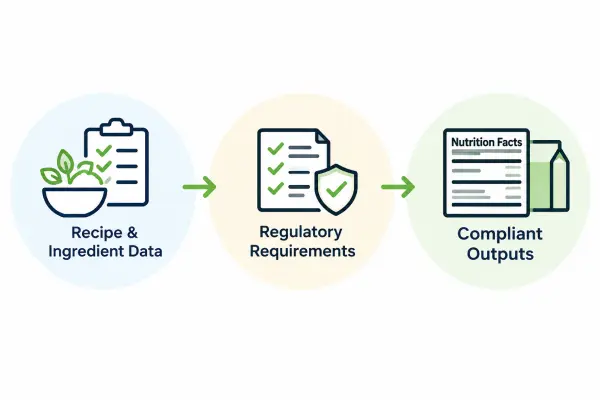
A practical way to think about compliance at scale is as a connected system with three parts.
Source information: Recipes, sub-recipes, yields, serving sizes, ingredient specifications, supplier data, and allergen information. This is the underlying product information that needs to remain current as formulations and ingredients change.
Market-specific rules: Nutrition information may need to be calculated, rounded, formatted, and presented differently depending on the applicable market. Ingredient declarations, allergen labelling, claims, and front-of-package requirements may also vary. This is why the same underlying formulation can require different regulatory outputs depending on where the product is sold.
Regulatory outputs: The source information and applicable requirements ultimately support several outputs, including:
- Nutrition values
- Nutrition labels
- Ingredient declarations
- Allergen statements
- Nutrition claims
- Front-of-package information
- Regulatory and nutrition reports
- Other packaging information
A formulation change can affect several of these outputs at the same time. Replacing an ingredient, for example, may change the nutrition values, alter the ingredient declaration, introduce an allergen, or affect whether a nutrition claim still applies.
When the source information, applicable requirements, and regulatory outputs are managed as parts of the same process, teams have a clearer way to review what needs attention when something changes. When they are disconnected, updates can become a hunt across files, folders, spreadsheets, and versions.
Build a Repeatable Compliance Workflow
Technology alone does not solve compliance management. Businesses also need a consistent process for what happens when product information changes. A practical workflow might include the following steps:
1. Update the source information
Record the ingredient, supplier, recipe, yield, serving size, or formulation change in the system where the product data is maintained.
2. Recalculate nutrition
Review the updated nutrition analysis using the revised formulation.
3. Review ingredient declarations and allergen labelling
Determine whether the change affects the ingredient declaration, sub-ingredients, allergen information, or related product information.
4. Review applicable labelling requirements
Check whether the updated values affect the nutrition label, claims, front-of-package requirements, or other relevant outputs.
5. Generate updated outputs
Create the updated nutrition label and any other required information from the revised product data.
6. Review before release
Regulatory or quality teams can verify the updated information before packaging or product changes move forward.
The objective is consistency. Instead of deciding from scratch what needs to happen every time a recipe changes, the food business has a repeatable process for moving from product data to compliant outputs.
Managing Multi-Market Nutrition Labelling (Canada, US, UK)
Complexity increases again when products are sold in more than one country. A formulation may remain the same while the required label changes depending on where the product is sold.
Canada, the United States, and the United Kingdom, for example, have their own nutrition labelling requirements, formats, and regulatory frameworks. Ingredient declaration rules and allergen labelling expectations can also differ.
That creates another potential data-management problem. Organizations can either create separate workflows for every market or maintain the core product information centrally and use it to support the appropriate outputs for each market. The second approach reduces unnecessary duplication, and the recipe remains the same. What changes is how that information needs to be calculated, formatted, rounded, or presented for the applicable market, along with the specific regulatory outputs required.
For food businesses expanding internationally, this distinction becomes increasingly important. Otherwise, one product can gradually turn into several disconnected sets of nutrition and labelling data simply because it is sold in different countries.
Create a Single Workflow From Recipe to Label
This is where MenuSano can support growing food businesses. MenuSano brings recipe management, nutrition analysis, custom ingredients, allergen information, reporting, and nutrition labelling into one platform.
Instead of calculating nutrition in one place and then manually recreating that information somewhere else for labelling, the recipe becomes the foundation of the workflow. That helps reduce duplicate data entry and gives teams a more consistent way to work with recipe, nutrition, allergen, and labelling information.
Teams can build recipes from food composition database ingredients or their own custom ingredients, analyze the formulation, review nutrition information, and use that data to create the required label and related regulatory outputs.
Recipes can also be used within other recipes, combined recipes, which is particularly important for manufacturers and foodservice businesses working with components such as sauces, fillings, doughs, bases, and other shared formulations. As those components change, maintaining them within a connected recipe structure makes it easier to manage how products are built, rather than treating every finished product and label as completely separate.
MenuSano supports nutrition and labelling workflows for Canada, the United States, and the United Kingdom, allowing businesses operating across markets to work with their product information without building an entirely separate nutrition workflow for each country.
Compliance at Scale Is a Data Management Problem
For a business with a handful of products, nutrition labelling can feel like a document-generation task. For a business with hundreds of products, it becomes a data-management problem. The challenge is maintaining the relationships between recipes, ingredients, nutrition information, allergen labelling, regulatory requirements, and labels as products continue to change.
That is why scaling compliance is not simply about generating labels faster. It is about creating a reliable system for managing the information behind those labels. When product data is connected, a recipe change is no longer just another spreadsheet update or another label file to replace. It becomes part of a structured workflow in which the organization can review the change, understand its impact, update the necessary information, and generate the appropriate outputs.
For growing food businesses, that connected approach provides a stronger foundation for managing nutrition and label compliance across an expanding product portfolio.