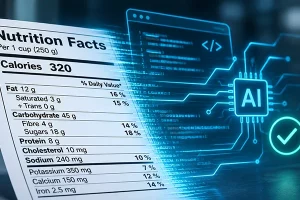


For enterprise food businesses, compliance matters for a practical reason: mistakes can be expensive.
A nutrition label is based on a specific formulation at a specific point in time. Change an ingredient, supplier, serving size, yield, or quantity, and the nutrition information behind that label may change too.
For food businesses managing dozens or hundreds of products, this creates an easy-to-underestimate challenge: how can you ensure every label accurately reflects the recipe your business currently produces?
Key Takeaways
- A nutrition label can start out accurate but become outdated when a business changes its recipe.
- Recipe changes don’t just affect “nutrition.” They can trigger updates to labels, ingredient lists, allergen information, and packaging/marketing claims.
- The compliance risk increases with scale: more products, more sub-recipes, more suppliers, and more change events.
- The enterprise challenge isn’t making a single update; it’s identifying which products a change affects and which downstream outputs require review.
- Spreadsheets make this harder because they don’t automatically connect recipes, ingredient specifications, nutrition calculations, allergens, and labels.
- Connecting recipe data directly to nutrition analysis and labelling makes it easier to identify and review downstream changes.
A Nutrition Label Is Only as Current as the Recipe Behind It
A nutrition label isn’t a standalone deliverable. It’s the output of a chain of connected inputs: Recipe/formulation, ingredient data, nutrition analysis, and nutrition label. That relationship matters because businesses must manage these interconnected tasks continuously, rather than treating them as one-time activities. A change upstream can affect everything downstream.
If a business changes a recipe without updating its nutrition analysis and label, the label may become inaccurate without anyone noticing.
Recipe Changes That Can Affect Nutrition Labels
A label issue can start long before someone edits the label itself. If a business changes a recipe without reviewing its downstream impact, the nutrition information may no longer match the product it produces.
Common changes that can shift nutrition values and label outputs include:
Ingredient substitutions: Replacing one ingredient with another can change calories, fat, sodium, sugars, fibre, and micronutrients. It can also change declared allergens.
Supplier changes: Two “equivalent” ingredients can have different nutritional specifications depending on supplier, processing method, or fortification.
Quantity adjustments: Small formulation tweaks can alter nutrient values per serving, especially for sodium, sugars, saturated fat, and protein.
Serving size changes: Changing the declared serving size affects the nutrition values consumers see and can influence how they perceive the product. Convert to PDF
Yield and cooking changes: Moisture loss, final cooked weight, and yield affect per-100g and per-serving calculations. If yield assumptions drift, nutrition values drift too.
New sub-recipes or components: Updating a sauce, filling, dough, seasoning blend, or premix can affect every finished product that uses it.
One Recipe Change Can Create Multiple Compliance Tasks
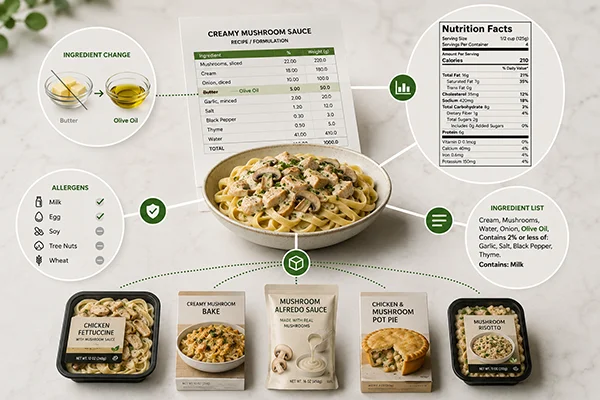
A recipe change rarely affects just the nutrition label; it often triggers additional compliance requirements.
A formulation change may require a business to review multiple downstream outputs:
Nutrition Values: Does the existing nutrition analysis still accurately represent the product being produced today?
Nutrition Facts Label: Do nutrient values, serving information, or other label elements need updating?
Ingredient Lists: Has the ingredient composition changed, or the ingredient order?
Allergen Information: Has the new formulation introduced or removed a declared allergen, or changed the allergen information that needs to be reviewed?
Nutrient and Product Claims: A reformulation can also affect whether a product continues to meet regulatory requirements for nutrient-content claims such as “low sodium,” “source of fibre,” or “high protein.” Requirements vary by market, so claims should be reviewed whenever the underlying formulation changes.
This reinforces a key point: compliance isn’t “generate a label once.” It’s maintaining label accuracy as recipes evolve.
The Enterprise Problem: Recipe Changes Don’t Happen in Isolation
A small company might manage a handful of recipes. An enterprise food business may manage hundreds of formulations, sub-recipes, suppliers, products, and labels. Now imagine that a company changes one sauce used across 24 finished products.
The question isn’t simply: “Did we update the sauce?”
It becomes: “Which products use this sauce, and what else needs to be reviewed because it changed?”
That’s the real enterprise challenge: understanding impact, tracing dependencies, and keeping downstream outputs aligned with what’s actually being produced.
Why Spreadsheets Make This Harder
The problem isn’t necessarily that Excel calculates incorrectly. The problem is that spreadsheets don’t naturally maintain relationships between information.
When recipes, ingredient specifications, nutrition calculations, allergens, and labels live across different spreadsheets or systems, teams have to manually determine what a change affects.
That creates opportunities for:
- outdated nutrition information
- incorrect label versions
- missed allergen changes
- duplicate calculations
- inconsistent product information
- labels that no longer match current formulations
Compliance Is an Ongoing Process, Not a Final Step
Many teams treat compliance like a final milestone: create the recipe, calculate nutrition, generate the label, and move on. But in real-world food operations, compliance is a lifecycle.
As recipes, suppliers, serving sizes, yields, and regulations change, businesses must continuously review and update their nutrition analysis and labels rather than treat compliance as a one-time task.
For enterprise food businesses, compliance becomes a food data management problem, partly because of keeping recipe data, nutrition analysis, allergens, and label outputs current as the business changes.
Building a Better Recipe-to-Label Workflow

A stronger workflow keeps recipe management, nutrition analysis, allergen review, labelling, and reporting connected in one continuous process.
When the underlying recipe changes, teams can quickly see what downstream information depends on it and review what needs attention, without recreating work or manually reconciling data across disconnected files. That reduces the gap between what’s being produced and what’s being declared.
If a recipe change affects nutrition values, serving information, ingredient lists, or allergens, businesses should review the label to determine whether they need to update it. Since the label reflects a specific formulation, any changes may cause it to differ from the product the business currently produces.
Yes. Two ingredients that seem equivalent can have different nutritional specifications depending on supplier, processing method, fortification, or moisture content. Supplier changes should trigger a review of nutrition analysis and any label outputs that depend on that ingredient data.
There isn’t one universal schedule that fits every business or market. A practical approach is to review labels whenever there’s a formulation, supplier, serving size, or yield change, and to run periodic audits across product lines to catch drift over time.
Reduce the Risk of Outdated Nutrition Labels
As food businesses grow, relying on someone to remember every downstream impact of a recipe change becomes increasingly difficult.
The challenge isn’t simply recalculating nutrition. It’s about keeping the recipe, nutrition calculations, allergen information, and customer-facing label accurate and consistent as the product changes. That’s where a connected system becomes valuable.
MenuSano is built around that connected workflow, bringing recipe management, nutrition analysis, allergen management, and nutrition labelling into one platform. As a result, when formulations change, teams can recalculate nutrition information and review updated label data without rebuilding the process across disconnected spreadsheets and files.
For businesses managing growing product lines, sub-recipes, and frequent formulation changes, this creates a more manageable path from recipe change to compliance review.
It’s a practical way to keep labels current as recipes evolve, without turning every change into a manual reconciliation project.