Key takeaways
- Working software ≠ compliant software. Labels must be validated, not just generated.
- Regulations change. Software needs ongoing updates and re-testing.
- AI code can be insecure. Security still requires human review.
- Architecture matters. Testing, backups, logs, and monitoring aren’t optional.
- Calculations are nuanced. Data + correct rules + domain expertise.
- Plan for vendor risk. Ensure data ownership and export options.
- Ask hard questions. A good provider answers transparently.
- AI helps, but accountability wins. Compliance needs proof, not promises.
Artificial intelligence is changing the software industry at an extraordinary pace. Today, someone with an idea and access to AI development tools can create a website, build an application, connect a database and launch a software product in a fraction of the time it once required. This approach is often called vibe coding.
It’s an exciting development. AI is making software creation more accessible, reducing development costs and helping businesses innovate faster.
But there’s an important question that deserves more attention:
Just because AI can build software, does that mean it’s ready to handle something as important as regulatory compliance?
For food manufacturers, restaurants and businesses responsible for producing accurate nutrition labels, the answer requires careful consideration.
A nutrition label isn’t simply a collection of numbers displayed in an attractive format. It represents nutritional calculations, ingredient information, regulatory requirements and data that consumers rely on when making food choices.
And behind every compliant label should be technology that has been properly designed, tested, maintained and reviewed.
A Working Application Isn’t Necessarily a Compliant Application
One of the biggest misconceptions about software development is that if an application works, it must have been built correctly.
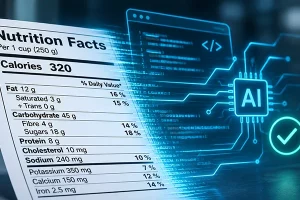
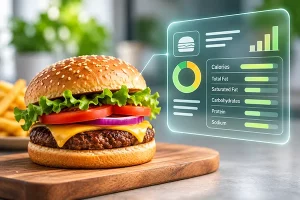
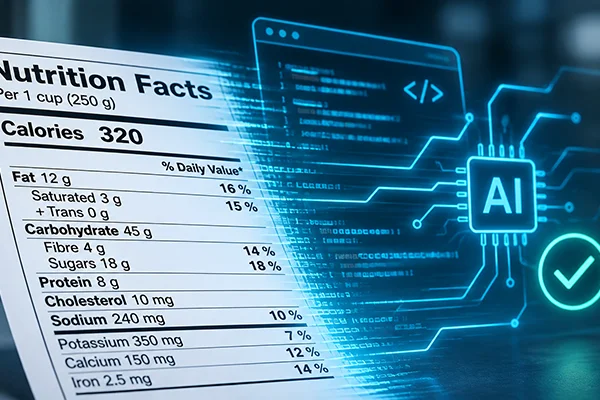
A user enters ingredients, clicks a button and receives a professional-looking Nutrition Facts table.
Everything appears to work. But what happens behind the scenes?
Does the software use appropriate nutritional databases? Does it calculate nutrient values correctly? What about rounding rules? Does it account for serving sizes, ingredient yields and recipe preparation? Does it generate labels according to the regulations of the intended market?
These are not simply interface features. They require carefully designed calculations, validated business logic and an understanding of food labelling requirements.
An AI development tool can generate code that produces a Nutrition Facts table. That alone does not establish that the calculations or label format are accurate.
In Canada, the Canadian Food Inspection Agency (CFIA) outlines how nutrition information is assessed for accuracy through its Nutrition Labelling Compliance Test.
For food businesses, an incorrect label can mean more than an inconvenient software error. Depending on the circumstances, it may lead to relabelling costs, product withdrawals, regulatory action or damage to customer trust.
The real question isn’t whether software can generate a nutrition label. It’s whether the information and regulatory logic behind that label can be trusted.
Food Labelling Regulations Change. Is Your Software Keeping Up?
Nutrition labelling is not a one-time development project.
Regulations evolve. Governments introduce new requirements, revise nutrient declarations, update formatting rules and establish new compliance deadlines.
Consider Canada’s front-of-package nutrition labelling requirements. As outlined in the CFIA’s food labelling implementation guidance, the transition period ended December 31, 2025, with the new requirements generally applying to products imported, manufactured or packaged at retail beginning January 1, 2026, subject to the applicable rules.
For software providers, regulatory changes can require much more than updating a few lines of text. They may involve changes to calculations, label layouts, nutrient thresholds, conditional rules and customer workflows.
A software application built quickly with AI may work well against the requirements originally provided to it.
But who is responsible for identifying regulatory changes six months later? Who determines how those changes affect the software? Who tests the updated calculations before customers begin using them?
AI doesn’t automatically provide an ongoing regulatory monitoring program.
Compliance requires continuous maintenance, not just a successful product launch.
Before choosing nutrition labelling software, businesses should understand how regulatory updates are monitored, reviewed, implemented and communicated.
AI-Generated Code Can Introduce Cybersecurity Risks
Vibe coding can accelerate development, but speed does not replace secure software engineering.
Applications that store recipes, ingredient formulations, supplier information and proprietary product data need appropriate security controls.
Potential vulnerabilities include:
- Inadequate authentication or access controls
- Improperly protected databases
- Exposed API keys or credentials
- Outdated or vulnerable software dependencies
- Insufficient separation between customer accounts
- Missing security monitoring, backup or recovery procedures
These problems are not exclusive to AI-generated software. Traditionally developed applications can have the same weaknesses.
However, AI-assisted development can introduce additional risks when generated code is deployed without sufficient human review.
The Open Worldwide Application Security Project (OWASP) highlights these concerns in its Secure Coding with AI guidance, emphasizing the importance of reviewing and validating AI-generated code before deployment.
A visually polished application tells customers very little about the security of the systems operating behind it.
A professional-looking website is not a cybersecurity assessment.
Before uploading proprietary recipes or product formulations, food businesses should ask how their information is protected, who can access it and what happens if a security incident occurs.
Who Has Reviewed the Software’s Technical Architecture?
There is a difference between creating an application and engineering a dependable software platform.
A production system may require architecture decisions that are largely invisible to customers.
These can include database design, access permissions, error handling, automated testing, backup and recovery, monitoring, audit logs and secure deployment procedures.
When software is built primarily through AI-generated instructions without appropriate technical oversight, important requirements can be overlooked.
The application may function during a demonstration while still having weaknesses that become apparent when customer numbers grow, data volumes increase, or unexpected conditions occur.
This is why technical reviews matter. The National Institute of Standards and Technology (NIST) also emphasizes the importance of integrating security throughout the software development lifecycle in its DevSecOps guidance.
Depending on the application’s risks, appropriate assurance may include:
- Code reviews by qualified developers
- Automated functional and regression testing
- Security vulnerability scanning
- Penetration testing
- Review of database access and customer data separation
- Testing of backup and recovery procedures
- Independent technical or security assessments where warranted
Not every software provider needs the same certification or audit. But every provider should be able to explain how its application is tested and maintained.
AI can help developers write code. It cannot replace accountability for the quality of the finished system.
Nutritional Calculations Require More Than a Database
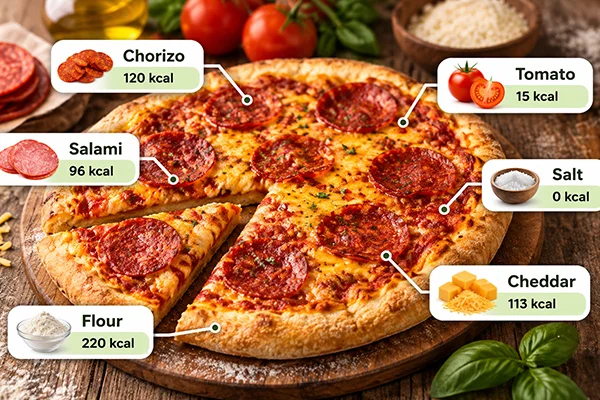
Nutrition analysis software depends on the quality of its data and the rules used to interpret that data.
A calculation may involve ingredient selection, nutrient values, quantities, serving sizes, processing adjustments, yields and regulatory rounding.
If an ingredient is matched incorrectly, the resulting calculation can be wrong. The nutrition information per serving may be misleading, if a recipe’s yield is handled incorrectly. If the software applies the wrong regulatory rounding rules, even otherwise reasonable nutrient calculations can produce an incorrect label.
These are examples of why nutrition software requires specialized domain knowledge and testing.
The US Food and Drug Administration (FDA) provides guidance on developing and using databases for nutrition labelling, reinforcing the importance of reliable nutritional data and appropriate calculation methods.
Software can support the process, but it does not remove the food business’s responsibility to verify the information used on its labels.
The accuracy of a nutrition label depends on both reliable source data and correctly implemented calculations.
What Happens to Your Data If the Software Company Disappears?
This is another question that food businesses should consider before selecting a new software platform. Recipes and product formulations are valuable business assets.
Over time, a company may build an extensive library of ingredients, nutritional calculations, product specifications and labels.
What happens if the software provider stops operating, changes its pricing model or discontinues the product? Can customers export their information? Do they retain ownership of their recipes and formulations? Are there contractual protections governing how their data is used and shared? Is there a documented process for retrieving information when a subscription ends?
These questions matter regardless of whether the software was built using AI. Businesses should not have to lose access to years of product development information simply because they decide to change technology providers.
Seven Questions to Ask Before Choosing Nutrition Labelling Software
Before committing to any nutrition analysis platform, ask:
- How are nutritional calculations validated? Can the provider explain the databases, calculation methods and testing processes used?
- How do you stay current with regulatory changes? Who monitors new requirements, and how are updates implemented?
- What technical and security reviews have been performed? Are code reviews, vulnerability assessments or independent audits part of the development process?
- How is customer data protected? What safeguards prevent unauthorized access to recipes, formulations and business information?
- Who is responsible for maintaining the software? Is there a qualified team supporting the application after launch?
- What happens if something goes wrong? Does the provider have support, incident response and recovery procedures?
- Who owns the data, and can it be exported? Can customers retrieve their information when they leave?
A trustworthy provider should be willing to discuss these questions openly.
AI Has a Place in Nutrition Technology. But So Does Accountability.
At MenuSano, we believe AI has enormous potential to improve how software is developed and how food businesses operate.
AI can accelerate innovation, improve workflows and help software teams deliver valuable functionality more efficiently. The concern is not the use of AI.
The concern is treating AI-generated functionality as a substitute for validated calculations, secure engineering and ongoing regulatory oversight.
Nutrition labelling software operates in an environment where accuracy matters, regulations change, and businesses depend on the information their systems generate.
That responsibility deserves more than an attractive interface and a working demonstration. Whether a platform is newly launched or has been operating for years, customers should expect transparency about its technology, testing, data protection and compliance maintenance. Because when it comes to nutrition labelling, building software is only the beginning.
Maintaining trust is the real responsibility.
Choosing Nutrition Analysis Software for Your Business?
MenuSano helps food manufacturers, restaurants and food businesses manage nutrition analysis, recipes, allergens and food labelling workflows. If you’re evaluating nutrition analysis software, we’d be happy to discuss your requirements and demonstrate how MenuSano works.