

Nutrition Labelling and The CFIA
Accurate nutrition labelling is crucial, and your products must comply with industry standards set by regulatory bodies. These changes can benefit you in many ways. Your labels will promote transparency and allow you to build trust with your customers.
Correct nutrition information is vital for health-conscious consumers looking to make informed decisions. Today’s diners continuously demand accuracy and integrity from foodservice providers. Simply put, they want a company that they can trust.
The Canadian Food Inspection Agency (CFIA) is a regulatory body dedicated to protecting Canadian citizens from preventable health risks caused by food and zoonotic diseases. Health Canada’s responsibility includes helping Canadians enhance and manage their health. Nutrition labelling regulations are developed by Health Canada, and the CFIA is responsible for enforcing these requirements.
On December 14, 2016, changes to the Food and Drug Regulations regarding nutrition labelling, ingredient lists, and food colour requirements were published. A five-year transition period has been authorized for the industry to comply with these new changes. Adjustments to food colour requirements and the elimination of the synthetic colour certification specification are effective immediately. It is currently proposed that the transition period be extended to December 14, 2022.
Food and Drug Regulations Nutrition Labelling Amendments in Canada
The purpose of these changes is to ensure that the labelling information on prepackaged food products is more valuable and easier to read for Canadians. Health Canada and the CFIA have prepared a guide for foodservice professionals, academics, and government agencies in generating accurate nutritional values, and this article will help you navigate these new regulations.
Please be aware that the CFIA also uses the Nutrition Labelling Compliance test to ensure the accuracy of nutrients listed on food labels and in ads. It also determines whether the labels and claims comply with the Food and Drug Regulations.
Keep in mind that during the five-year transition period, manufacturers must comply with either the new or the former labelling requirement. At the end of the transition period, compliance with the new regulations is required for all prepackaged food products manufactured or imported as of December 15, 2021.
Objectives of the Nutrition Labelling Specs
Regulations on Canada’s nutrition facts labels have been designed to convey information about the nutrient content of food in a standardized format. At the point of purchase, consumers are more aware of the differences in food products. The goal is to help consumers make healthy food choices.
Nutrition Facts Table Requirements
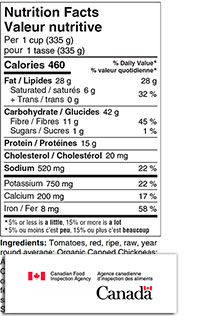
The Food and Drug Regulations state that the Nutrition Facts table (NFt) is required for most prepackaged foods. The label should carry a nutrition facts table that includes:
- the serving of stated size
- energy value
- amount of fat, saturated fatty and trans fatty acids
- The sum of saturated fatty and trans fatty acids
- amount of cholesterol, sodium, carbohydrates, fibre, sugars, protein, potassium, calcium, and iron
- % Daily Value interpretative statement
Prohibitions
Prohibitions: Certain foods or types of foods are specifically prohibited from displaying a Nutrition Facts table. They have their own nutrition labelling requirements. These include:
- formulated liquid diets
- infant formula and foods containing this
- meal replacements
- foods presented for use in low-energy diets
- nutritional supplements
Exemptions
Certain prepackaged products are always exempt from showing a Nutrition Facts table:
- a fresh vegetable or fruit, or any combination of fresh fruits or vegetables, without any added ingredients
- milk, skim milk, partly skimmed, goat’s milk, partly skimmed goat’s milk, skimmed goat’s milk, cream sold in a refillable glass container, (naming the flavour) milk, (naming the flavour) partly skimmed milk or (naming the flavour) skim milk
- a prepackaged individual portion of food that is only intended to be provided by a restaurant or commercial enterprise, with snacks or meals
Some prepackaged products are usually exempt from the Nutrition Facts table requirement. These include:
- a product for which all the information set out in column 1 of the table in the FDR, other than in relation to serving of stated size, may be expressed as “0” in the Nutrition Facts table
- a beverage with an alcohol content of over 0.5%
- raw single ingredient meat, meat by-product, marine or freshwater animal product, poultry meat or poultry meat by-product
- sold only in the retail establishment where the product is processed from its ingredients and prepared
- sold only at a flea market, fair, farmers’ market, road-side stand, craft show or sugar bush by the person who processed and prepared the product
- An individual serving that has not been processed to extend its life and is sold for immediate consumption
- sold only in the retail establishment where the product is packaged, if the product is labelled with a sticker and has a display surface of fewer than 200 cm2.
Declaring Nutrition Information

As a food service provider, it is your responsibility to display accurate information in your Nutrition Facts Labels. This can be done through nutrition analysis software or laboratories. To get started, here are some steps that you need to consider when developing accurate nutrient values:
- Figure out how you will be using the nutritional values
- Collect all of your product information
- recognize and assess your options
- analyze gaps and prepare to solve them
- determine and apply an approach
- Be sure to measure and document the results of your approach
Positive Features of Databases and Software
- The source of the data is reputable
- The data is recent and can be exported with ease
- includes all mandatory nutrients and elements for claims and the Nutrition Facts table
- flexible and can add custom ingredients
- Nutrition Facts table format complies with CFIA and Health Canada
- Presentation of the Nutrition Facts table that can be affixed to the product is legible and meets the graphic and technical requirements of the FDR
Comply with CFIA Standards
CFIA’s labelling framework is detailed, and foodservice providers should recognize its importance. You don’t want to leave anything to chance when it comes to your nutrition facts labels. MenuSano provides the solution for implementing these new acts and regulations. Our nutrition analysis software helps foodservice providers stay compliant with all required labelling requirements.
MenuSano is an essential tool that lets you quickly and accurately determine the nutritional information for your products and dishes. You simply enter the ingredients, assembling them into recipes, and print out your new labels with such ease. The process is quick, affordable, and can be done in-house.
You do not have to deal with lab fees or long wait times. You can print off your nutrition facts labels, and they are readily available online.
MenuSano is a nutrition facts label creator that helps you produce reliable labels without starting from scratch each time. Nutrition analysis software is built in, so your calculations and label outputs stay aligned. Try our free trial today.